
Stage‑Specific Effects of Maternal Circadian Rhythm Disruption
during Pre‑Pregnancy, Pregnancy, and Lactation on Behavioral
and Neurobiological Outcomes in Male Rat Offspring
Yeganeh Derakhshan1
· Shima Mohammadi2,3 · Amir Atashi4
· Parham Reisi5
· Behzad Garmabi2,3 ·
Seyed Davar Siadat6
Received: 10 November 2025 / Accepted: 29 August 2026
© The Author(s), under exclusive licence to Springer Science+Business Media, LLC, part of Springer Nature 2026
Abstract
Maternal circadian rhythm disruption (CRD) during reproduction is increasingly recognized as a risk factor for long-term
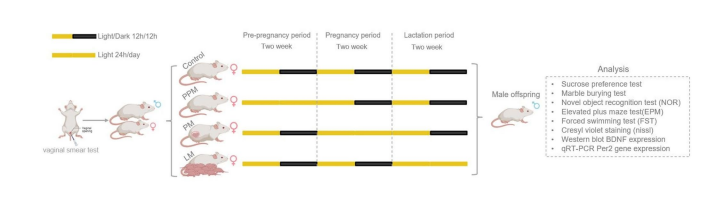
neurobehavioral disturbances in offspring. However, the stage-specific consequences of maternal CRD remain poorly understood. This study investigated the effects of maternal CRD during distinct reproductive phases, pre pregnancy mother (PPM),
pregnancy mother (PM), and lactationg mother (LM) on behavioral and molecular, and structural outcomes in male offspring.
Nulliparous Wistar rats were exposed to constant light (300 lx, 14 days) to induce CRD, while controls remained on a 12:12
h light/dark cycle. Male offspring were assessed for anxiety-like behavior (Elevated Plus Maze), depressive-like behavior
(Forced Swim Test), hedonic behavior (Sucrose Preference Test), compulsive-like behavior (Marble Burying Test), and
recognition memory (Novel Object Recognition Test). Histological analysis of the hippocampal CA1 region and expression
of Brain-Derived Neurotrophic Factor (BDNF) and PER2 were also evaluated. PPM and PM offspring exhibited increased
anxiety- and depressive-like behaviors, reduced body weight, alterations in hippocampal CA1 morphology, and molecular
changes, including decreased hippocampal BDNF expression in the PM group and reduced SCN PER2 expression in the
PPM group, without significant impairments in hedonic or recognition memory performance. In contrast, LM offspring
exhibited fewer behavioral alterations compared with the other experimental groups, suggesting a differential effect of the
timing of maternal circadian rhythm disruption on offspring outcomes. Considering the functional and neurodevelopmental
similarities between late gestation in humans and early postnatal development in rodents, these findings suggest that the
timing of maternal circadian rhythm disruption may differentially influence offspring neurodevelopment. However, because
these observations were obtained in an animal model, their relevance to human pregnancy should be interpreted with caution
and requires confirmation in future clinical and translational studies.
Keywords Circadian rhythm · Brain-derived neurotrophic factor · PER2 · Mood disorders · Behavior
20 جولای 2024
101 بازدید
شمیم
اشتراک گذاری